
20 October 2026
For five generations, the Williams family have farmed Turihaua Station, and looking after the land for those who come next has long been part of how the property is managed.
Today, Paul and Sarah Williams are continuing that legacy, building on decades of erosion control planting while adapting their approach to create a more resilient farm and landscape for the future.
“We have built off the back of historical plantings for erosion control and are now retiring areas to our benefit,” Paul says.
Much of that work began following Cyclone Bola, when widespread damage across the region highlighted the need to stabilise vulnerable land.
With support from the catchment board at the time, the family planted thousands of poplar and willow poles across the station. Their placement was deliberate, with different trees used according to the conditions and the type of erosion risk.
“The willows were planted up the gullies where there is more moisture and down the riverbanks to try and help bank erosion. Then the poplars were planted on the open faces where there was slipping and cracking appearing,” Paul says.
Those decisions made decades ago are still benefiting the property today.
Paul’s parents, Hamish and Ange, carried out extensive poplar and willow planting following Cyclone Bola, which helped protect the property when Cyclone Gabrielle arrived.
“Even in Cyclone Gabrielle, we weren’t as badly affected because the hills were protected by all their plantings.”
Over time, their approach has continued to evolve.
Paul says the property is now heavily planted, with relatively little erosion-prone land left. While poplars and willows are mostly in areas that can still be grazed, the family is now increasingly looking at retiring other areas and planting them in natives for longer-term protection.
“We are now retiring blocks and filling them with natives, and that’s going to give that land a lot longer protection.”
For Paul and Sarah, deciding what to do with an area is not only about erosion risk. It also needs to make sense within the wider farming operation.
They have also looked at lower valley areas that weren't fitting well within the farming system, taking corners out of paddocks and retiring and planting those areas instead.
That practical approach is important to Paul, who says every farm has its own challenges, and there is no single solution that will work everywhere.
“Every property is different. There’s different farming policy, different farming systems, different environments as well. You can’t all be classed as one.”
The work is far from finished. Some of the poplars and willows planted by previous generations are now getting older and are shading and collapsing into pasture, creating new challenges as the family considers how those areas should be managed into the future.
They continue to plant poles where slips occur, while also looking at where native vegetation could provide more permanent protection.
Paul encourages other landowners to look at their properties in the same way, identify their highest-risk areas, and develop a long-term plan rather than trying to tackle everything at once. The Station was recently assisted with an erosion and sediment control plan prepared by Council.
Ultimately, the goal at Turihaua is a landscape that is better able to cope with whatever the future brings.
For Paul and Sarah, that resilience is another layer in a legacy that has been built over generations, and one they hope will leave Turihaua in an even stronger position for the next.
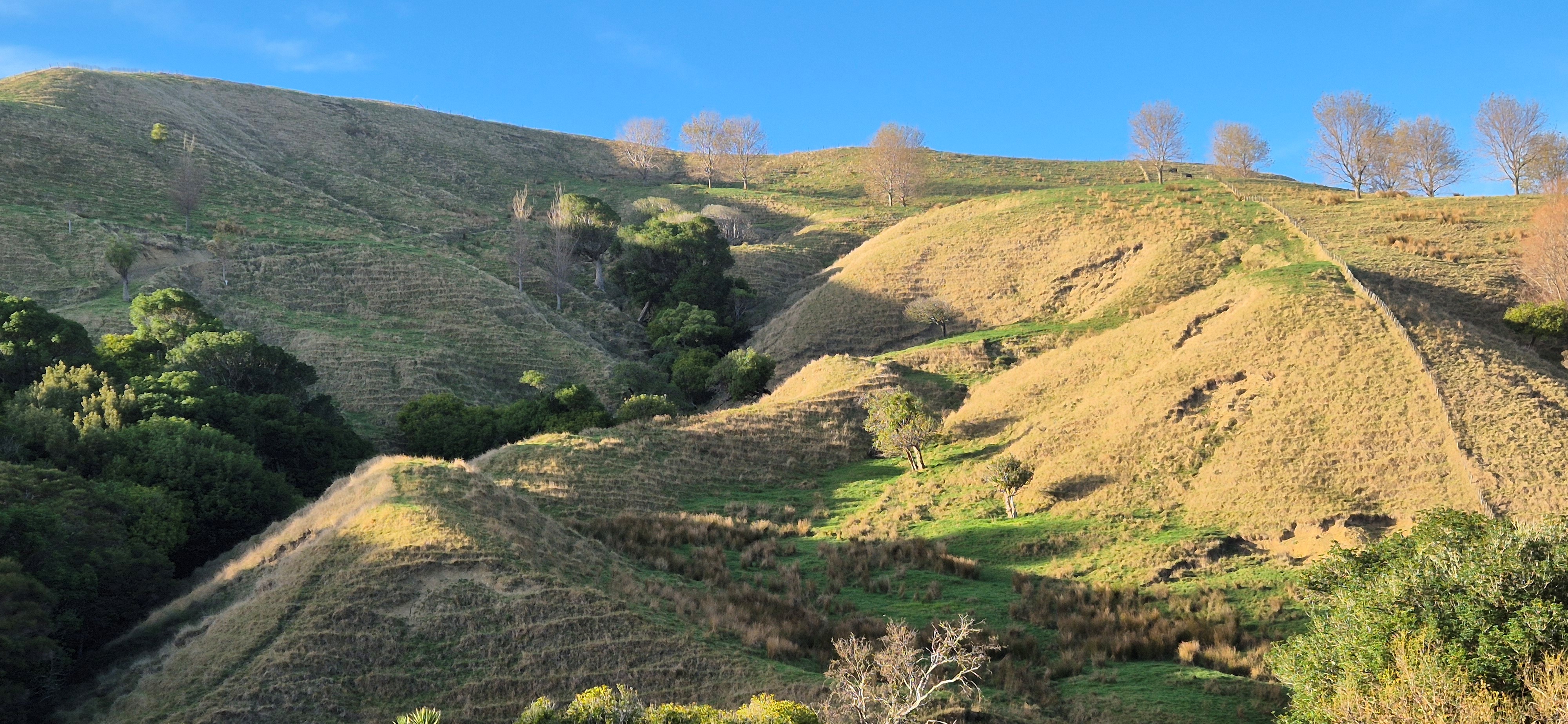
Photo: Toatoa showing a gully with a mixture of native and conservation trees